
For a while, posting on your Google Business Profile felt like dropping a note into a void. You'd publish an update about a promotion or a new service, and the only feedback was silence. Google has changed that. Post view counts are now visible directly in the profile dashboard, showing owners how many times each post appeared in Search and Maps results. It's a small feature. The implications for how Canadian small and mid-sized businesses should think about local content are not small at all.
What "post views" actually measures on Google Business Profile
The view count is an impression count: it tells you how many times the post appeared on a screen, whether in a Google Search panel or in Google Maps. It does not tell you the person read it, clicked it, or even noticed it. That distinction matters.
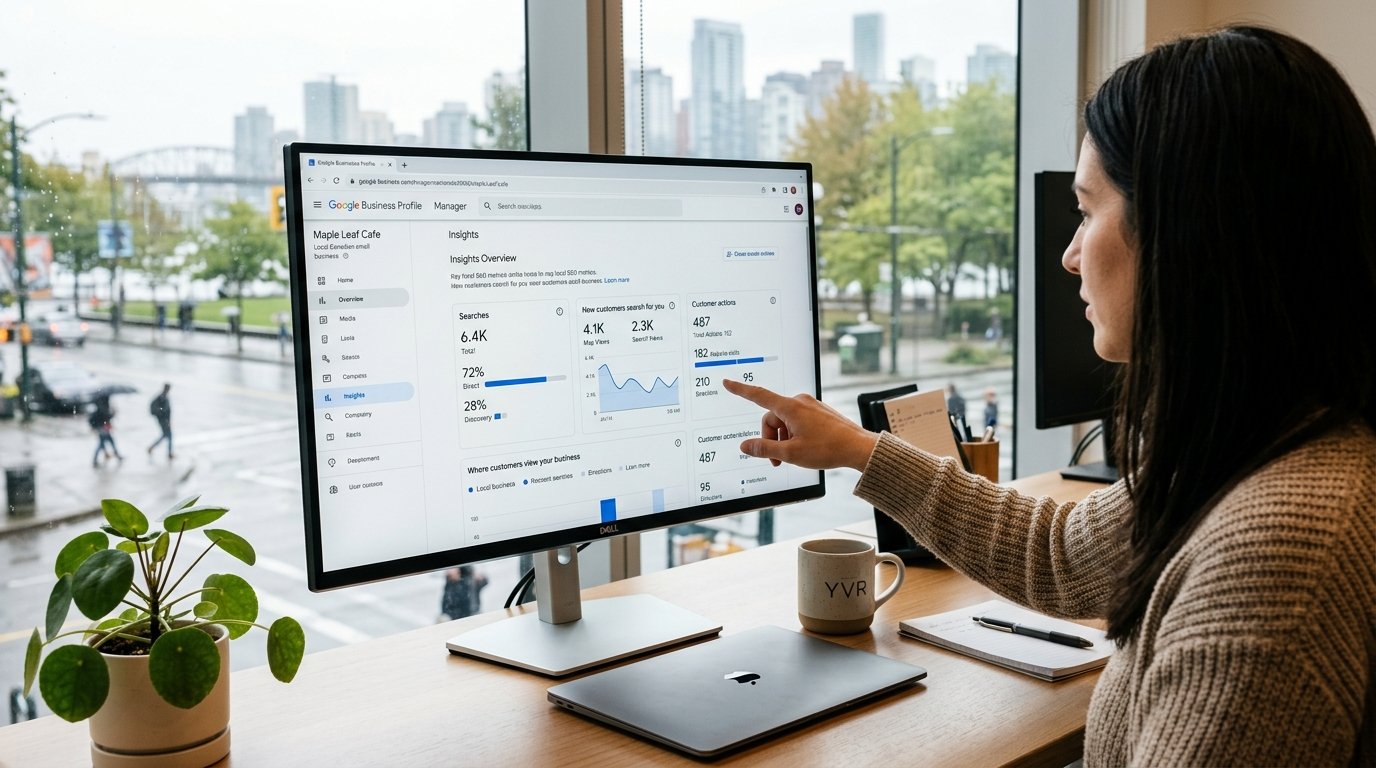
Think of it like a billboard on the 401. The traffic count tells you how many cars drove past. It says nothing about how many drivers actually looked up. What makes the GBP metric more useful than a billboard is that you can cross-reference it immediately with the actions taken from your profile: calls, direction requests, website clicks. Google's own documentation on Business Profile insights breaks down these action types. When a post racks up 600 views and generates zero direction requests, that's a clear signal the content didn't match what the searcher needed at that moment.
Impressions vs. engagement: the gap you should be watching
Most profile owners will look at a high view count and feel satisfied. That's the wrong read. The useful number is the ratio between views and downstream actions. A post about your new hours getting 400 views and 12 direction requests is performing. A seasonal promotion getting 900 views and no calls is not — and now you know that, instead of guessing.
This is the shift: you no longer have to assume your posts are working. You have data. Not perfect data, but enough to stop repeating content that doesn't move anyone.
How Canadian SMBs should use this data
The temptation is to chase views. Don't. Views are a means; calls and visits are the end. The smarter use of post view data is as a testing framework for your local content — specifically, to answer three questions before you settle into any posting habit.
Which topics actually get seen in your area?
Post view counts vary significantly by category, geography and competitive density. A plumber in Mississauga posting about emergency pipe repair will see different view volumes than a restaurant in Kensington Market posting about a weekend brunch special. There's no universal benchmark. What matters is your own baseline over 8 to 12 weeks of consistent posting.
Run a simple test: alternate between post types over a month. One week, a service-specific post ("we now handle commercial HVAC in Etobicoke"). The next, a time-sensitive offer. The next, a behind-the-scenes update. Track views and, more importantly, track whether any action follows. Across the SMB accounts we manage, offer posts and event posts consistently outperform generic updates on both metrics — but the gap varies enough by sector that you need your own data to be sure.
When do your posts get the most traction?
Google doesn't give you hour-by-hour post analytics the way Meta does. But you can infer timing patterns by noting when posts published on different days of the week accumulate views fastest. A post published Thursday evening before a long weekend will behave differently than one published Tuesday morning. Over two to three months, patterns emerge. Use them.
Does your call to action match the searcher's intent?
This is where most SMB posts break down. High views, no action usually means one of two things: the post appeared for a search query that wasn't ready to convert (someone researching, not buying), or the call to action was too vague to prompt anything. "Learn more" is not a call to action. "Book your free estimate this week — we have 3 slots left in Scarborough" is.
If you're running paid local campaigns alongside your organic profile, this distinction matters even more. Google Local Services Ads and your GBP posts are not the same tool — but they work better when the messaging is consistent across both.
What this means for your local content strategy
Post views give you something most local content tools don't: a feedback loop tied directly to the platform where local purchase decisions happen. That's not nothing. But it's only useful if you treat it as an input to a decision, not as a vanity metric to screenshot.
The practical implication for a Canadian SMB owner managing their own profile: stop posting by instinct and start posting by hypothesis. "I think posts about seasonal maintenance get more traction in September than in July" is a hypothesis. Post view data lets you confirm or kill it in six weeks.
For businesses with multiple locations — a franchise network, a multi-location retailer — this becomes more complex. Each location's profile generates its own data, and aggregating that across 10 or 14 locations to find patterns requires a process, not just a spreadsheet. When we built local page infrastructure for a franchise network of 14 locations, the ability to compare post performance across zones was one of the first things the network's operators asked for. The data was there; the system to read it wasn't. That's a solvable problem, but it needs to be designed deliberately.
If you want to know where your Google Business Profile fits into your broader local visibility picture, our local SEO audit checklist for Canadian SMBs is a good starting point. And if you'd rather have someone audit it, quantify the gap and build the system for you, that's exactly what our work looks like in practice.
Post views are a feature. Used well, they're a feedback mechanism. The businesses that will get the most out of this data are the ones that treat it as a question to answer, not a number to admire.
FAQ
What does the post view count on Google Business Profile actually measure?
It counts how many times a post appeared on screen in Google Search or Maps results, not how many people clicked it. A high view count with no direction requests or calls means the post was seen but didn't trigger action. That gap is the useful signal.
How often should a Canadian SMB post on Google Business Profile?
Consistency matters more than frequency. One well-targeted post per week, tied to a real offer or event, outperforms daily filler. Use the view count data to find which topics resonate in your specific area before committing to a cadence.
Does posting on Google Business Profile improve local search ranking?
Google has not confirmed posts as a direct ranking factor. They do keep your profile active and give searchers a reason to engage. Engagement signals (calls, direction requests, website clicks) from a post may indirectly support local ranking over time.
What types of posts get the most views on Google Business Profile?
Offer posts (with a clear discount or deadline) and event posts tend to generate more views than generic updates, based on what we observe across the SMB accounts we manage. Posts with a specific call to action and a real image outperform stock-photo updates consistently.