A client of mine, a family-run HVAC company in the GTA, asked me last spring why a competitor two towns over kept showing up when their customers typed questions into ChatGPT. Same services, similar prices, smaller operation. The answer had nothing to do with the competitor's marketing budget. It had everything to do with how that company had, probably without even realising it, built what I'd call decision coverage. My client had not.
This is the new reality of search in 2026. When someone asks an AI tool "who should I call for estate planning in Oakville" or "best commercial electrician near me," the tool doesn't browse the web in real time the way you might. It draws on everything it has already ingested: reviews, directories, articles, structured data on websites, mentions in local publications. It builds a picture of which businesses are credible enough to name out loud. If your business doesn't have that picture built, you simply don't get named. No malice. No algorithm targeting you. Just absence.
Why AI tools trust some businesses more than others
The confidence problem
Here's how to think about it. An AI tool, when asked to recommend a business, is doing something very close to what a well-connected friend does: it pulls together everything it knows about a category, filters for credibility, and names the options it feels confident about. Confidence, in this context, comes from corroboration. If five independent sources all say the same thing about your business, the AI has reason to trust that information. If only one source mentions you, or if the information is contradictory across sources, the AI hedges. It names someone else.
According to Google's own documentation on AI Overviews, the system prioritises content that demonstrates expertise, credibility, and clear information architecture. That's not a coincidence. It's a design choice. Google wants its AI to recommend businesses it can verify.
What corroboration actually looks like
For a Canadian SMB, corroboration is built from a handful of concrete things. Your business name, address, and phone number need to be identical across every directory that lists you: Google Business Profile, Yelp, Yellow Pages, industry-specific directories, your own website. Any inconsistency, a slightly different address format, an old phone number on an abandoned listing, a name that varies between "Smith Plumbing" and "Smith Plumbing & Heating," creates doubt. AI tools pick up on that doubt.
Reviews matter, but not just the star rating. The content of reviews matters. When a dozen clients describe your work in specific, detailed terms, "fixed our furnace the same day, explained everything clearly, no surprise charges," that language feeds into how AI tools categorise and describe your business. Generic five-star reviews with no text are nearly invisible to these systems.
Then there's your website. Not how beautiful it looks, but how clearly it communicates what you do, who you serve, and where you operate. AI tools read structured data, the behind-the-scenes information that tells them "this is a plumbing company, it serves the Mississauga area, it's been in business since 2014." Most SMB websites have none of that in place.
Why this is a strategy problem, not a tech problem
The instinct is to look for a quick fix
When business owners realise they're not showing up in AI recommendations, the instinct is to look for a button to press. Run an ad. Post more on Instagram. Ask a web developer to "do something for the SEO." I understand the impulse. The problem is that none of those actions address the underlying issue, which is that your business hasn't been built for the way AI tools evaluate credibility.
This is why I keep saying that strategy comes before execution. Before you spend a dollar on any marketing channel, you need to know exactly where you stand. What does your online presence actually look like from the outside? Where are the gaps? Which ones matter most given your market and your clients? That diagnosis shapes everything that follows. Without it, you're spending money on tactics that don't compound.
Decision coverage is a strategic asset
I use the term "decision coverage" to describe how completely a business shows up across the sources AI tools consult. Think of it as a score. A business with strong decision coverage has a complete, consistent Google Business Profile, appears in the right directories with matching information, has a steady stream of detailed reviews, has a website that clearly describes its services and service area, and has been mentioned in at least a few external sources: a local news piece, a supplier's partner page, an industry association listing.
A business with weak decision coverage has some of these things, but not all, and the ones it has are inconsistent or outdated. That's the majority of Canadian SMBs right now. Not because the owners are negligent, but because nobody ever told them this was the game being played.
The businesses that are winning AI recommendations in 2026 are not necessarily the best businesses in their category. They're the ones that built their decision coverage, intentionally or not, before AI search became the default way people find service providers.
What the audit actually reveals
The gaps are usually predictable
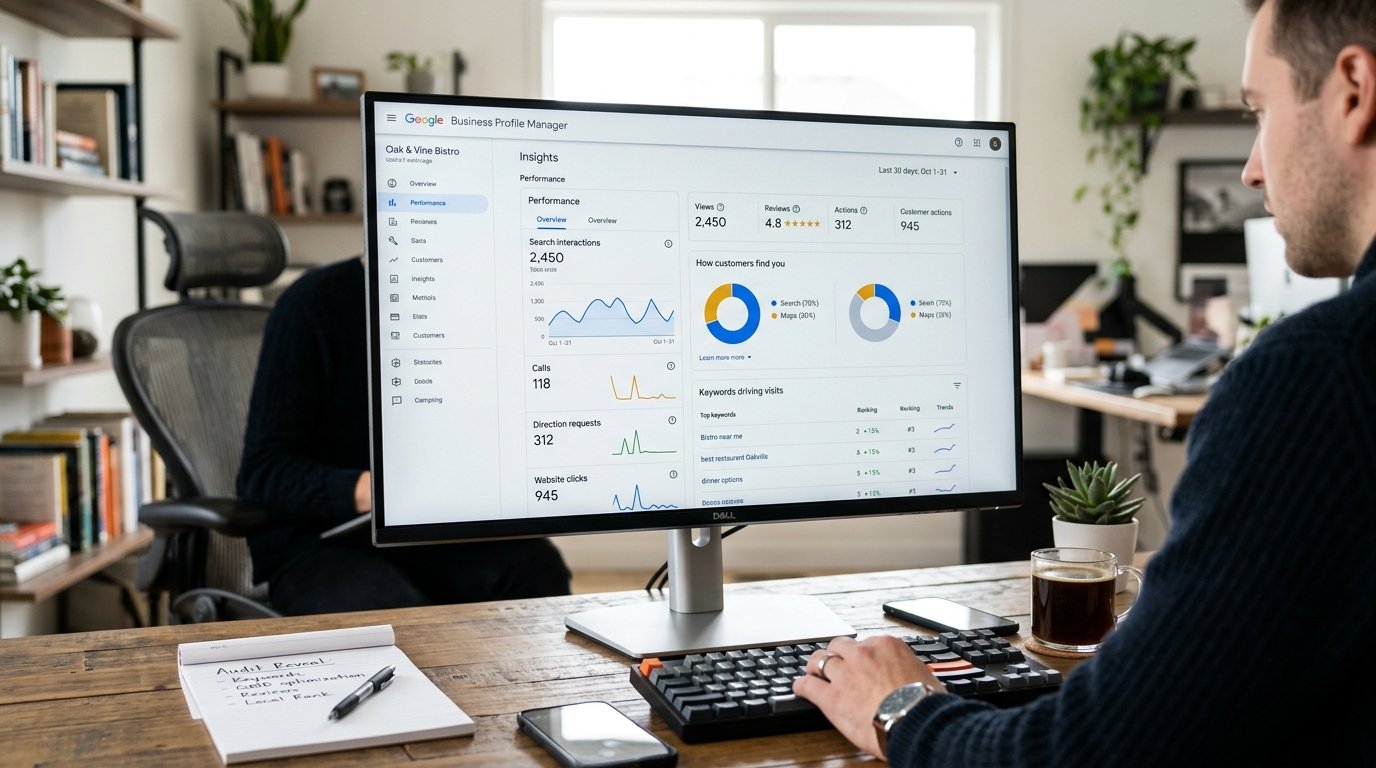
When I do a growth & operations audit for an SMB, the online presence piece almost always reveals the same pattern. The Google Business Profile was set up years ago and hasn't been touched since. The website says "serving the Greater Toronto Area" but doesn't name a single specific neighbourhood or postal code. There are 12 reviews, all from the first two years of operation, none since. The business appears in three directories, but the phone number is different in one of them because it was updated after a move and nobody remembered to change every listing.
None of these are catastrophic on their own. Together, they add up to a business that AI tools can't confidently recommend. The fix isn't complicated, but it has to be done systematically, not in a random afternoon of clicking around.
The cost of invisibility is real
Here's the business case, because I think it needs to be stated plainly. A growing share of purchase decisions, particularly for professional services and home services, now start with an AI query rather than a traditional Google search. Think with Google's research has tracked the shift in how users interact with search, and the direction is clear: AI-generated answers are capturing the top of the decision process. If you're not in those answers, you're not in the consideration set. You're not losing to a competitor on price or quality. You're losing before the conversation even starts.
For an SMB doing $1.5M in annual revenue, even a 10% increase in inbound inquiries from AI-referred clients is worth $150,000 in pipeline. That's not a marketing vanity metric. That's real revenue that either comes to you or goes to the competitor who built their decision coverage.
Why AI recommendations favour the prepared, not the biggest
Local and niche searches are where SMBs can win
This is the part I find genuinely encouraging, and I don't say that to soften a hard message. AI tools are particularly good at local and niche recommendations. When someone asks ChatGPT for the best immigration lawyer in Brampton, or a reliable powder coating shop in the Hamilton area, the AI isn't defaulting to the biggest national brand. It's looking for the most credible local option it can find. A well-reviewed, consistently listed, clearly described local business can absolutely outrank a national chain in those answers.
The barrier isn't budget. It's consistency and clarity. A plumber with 80 detailed Google reviews, a complete Business Profile, and a website that says "we serve Mississauga, Brampton, and Etobicoke" in clear text has a real shot at being the name ChatGPT drops when someone asks for a recommendation. Most plumbers don't have that. Which means the ones who do have a genuine advantage.
The compounding effect
Decision coverage builds over time. Every new review, every directory listing you clean up, every piece of structured data you add to your website, every article that mentions your business by name, all of it compounds. The businesses that start building this now will be significantly harder to displace in 12 months. The ones that wait will find the gap harder to close.
I've seen this play out concretely. The HVAC company I mentioned at the start of this piece spent three months systematically cleaning up their online presence, collecting reviews from past clients, and updating their website with proper location information. By month four, they were showing up in AI-generated answers for searches they'd never appeared in before. No ads. No viral content. Just the foundational work done properly.
Where to start if you want to be recommended by AI
Diagnose before you act
The single most useful thing you can do right now is get an honest picture of where you stand. Search for your own business the way a potential client would. Ask ChatGPT who it recommends in your category and your city. Check whether your information is consistent across Google, Yelp, and the top directories in your industry. Read your reviews as if you'd never seen them before.
What you find will tell you where to focus. Maybe the reviews are the gap. Maybe it's the website. Maybe it's the inconsistent listings. The answer is different for every business, which is why the audit comes before the action plan, every time.
Build the foundation, then maintain it
Once the gaps are identified, the work is sequential. Fix the information consistency first, because inconsistency actively undermines everything else. Then build the review volume, which takes time and a system for asking clients regularly, not just once. Then address the website's clarity and structure. Then look at whether you're being mentioned anywhere outside your own properties.
This is the kind of work that falls through the cracks at most SMBs because it doesn't belong clearly to any one person. It's not sales. It's not IT. It's not the office manager's job. It sits in the gap between functions, which is exactly why it doesn't get done. Our strategy services exist precisely to close that gap: to take the diagnosis, turn it into a prioritised plan, and make sure the execution actually happens and gets tracked over time.
FAQ
Why does AI recommend certain businesses and not mine?
AI tools recommend businesses that appear consistently across multiple trusted sources online: review platforms, directories, industry publications, and well-structured websites. If your business only exists in one place, or if the information about you is inconsistent, AI tools have no reason to trust or surface you.
What is decision coverage and why does it matter for SMBs?
Decision coverage is how broadly and consistently your business shows up across the sources AI tools consult when answering a user's question. A business with strong decision coverage gets named. One with gaps in its online presence gets skipped, even if it's the best option locally.
How long does it take to become visible to AI search tools?
There's no fixed timeline. In our experience, businesses that fix their foundational presence (consistent name, address, phone number across directories; real reviews; a clear website) start seeing improvements in AI-driven referrals within three to six months. The work compounds over time.
Is AI search visibility only for large companies?
No. Local and niche AI recommendations often favour smaller, well-reviewed businesses over large chains. A plumber with 80 detailed Google reviews and a clean website can outrank a national brand in ChatGPT's answer for "best plumber in Mississauga". The barrier is consistency, not budget.
What's the first step to improve my chances of being recommended by AI?
Start with an audit of your current online footprint: Google Business Profile, major directories, your website, and your reviews. Identify where your information is missing or contradictory. That diagnosis is the foundation. Without it, any other effort is guesswork.